Monday, April 10, 2006
What a Reformed Black Christian is Not...
According to our brother Xavier Pickett, it may be wise to understand what a Reformed Black Chrsitian is not, even as we express who we are. These 15 identity statements are provocative, clear, humorous, and true. While you're at Reformed Blacks of America, you may want to check out Lance Lewis' latest installment of Battle Stations.

Speaking of Conferences...
It appears that Carl Trueman has had enough of conferences. He is challenging us to think soberly about our approach to establishing and attending so many conferences. His thoughts are worthy of our careful and honest considerations. You can read his comments and the responses by Rick Phillips and others over at Reformation 21.
Saturday, April 08, 2006
Together for the Gospel
There is much discussion concerning unity. A few people have expressed concern that my lastest thoughts may engender disunity or at least put to risk the unity of the Reformed church. Listen, I have no intention of destroying the unity between blacks and whites within the Reformed church. Though I have not witnessed this mass expression of unity between blacks and whites, since I am not omniscient I will take other's word for it that this unity does exist. Therefore, let me say without horns that I am for unity. In fact, unity is one of the driving forces behind my push for  having our own.
You see, in a couple of weeks, some friends and I will have the opportunity to travel to Louisville and fellowship with over 2000 other men at Together For The Gospel Conference. I have long anticipated this event and am eager to be in attendance. Yet this conference strikes me as an amazing expression of disunity. You see, two of the primary architects of this conference are CJ Mahaney of Sovereign Grace Ministries and Ligon Duncan of First Presbyterian Church in Jackson, MS. Apparently these men are good friends and fellow citizens and members of the household of God. Yet they could not be more different. They have different views on church government, spiritual gifts, order of service, even proper attire :-). CJ could never pastor First Presbyterian and Ligon could never be comfortable in the Sovereign Grace movement. Ah, mayber for unity sake, someone needs to tell CJ he just needs to stop being who he is and join the PCA and become a member of First Presbyterian in Jackson. Does Ligon not realize that he is destroying the unity of Christians by not being a pastor in a Sovereign Grace church? Of course I speak foolish, but the point needs to be made. These men are friends and are unified and we need not question their unity, though different they may be. Unity is not sitting next to one another in church. Unity is not singing the same songs. Unity is not following the same order of worship. CJ is more unified with Ligon than he is with many who would hold to CJ's view of the spiritual gifts. Ligon is more unified with CJ than he is with many who hold to Ligon's view of church order. Likewise, I am more unified with my white Reformed brothers and sisters than I am with most of the Christians I know who are black. And just as CJ and Ligon do not have to be in the same church in order to express and appreciate that unity, I do not have to be in the same denomination or local church with my white reformed brothers and sisters to express and appreciate our unity.
 having our own.
You see, in a couple of weeks, some friends and I will have the opportunity to travel to Louisville and fellowship with over 2000 other men at Together For The Gospel Conference. I have long anticipated this event and am eager to be in attendance. Yet this conference strikes me as an amazing expression of disunity. You see, two of the primary architects of this conference are CJ Mahaney of Sovereign Grace Ministries and Ligon Duncan of First Presbyterian Church in Jackson, MS. Apparently these men are good friends and fellow citizens and members of the household of God. Yet they could not be more different. They have different views on church government, spiritual gifts, order of service, even proper attire :-). CJ could never pastor First Presbyterian and Ligon could never be comfortable in the Sovereign Grace movement. Ah, mayber for unity sake, someone needs to tell CJ he just needs to stop being who he is and join the PCA and become a member of First Presbyterian in Jackson. Does Ligon not realize that he is destroying the unity of Christians by not being a pastor in a Sovereign Grace church? Of course I speak foolish, but the point needs to be made. These men are friends and are unified and we need not question their unity, though different they may be. Unity is not sitting next to one another in church. Unity is not singing the same songs. Unity is not following the same order of worship. CJ is more unified with Ligon than he is with many who would hold to CJ's view of the spiritual gifts. Ligon is more unified with CJ than he is with many who hold to Ligon's view of church order. Likewise, I am more unified with my white Reformed brothers and sisters than I am with most of the Christians I know who are black. And just as CJ and Ligon do not have to be in the same church in order to express and appreciate that unity, I do not have to be in the same denomination or local church with my white reformed brothers and sisters to express and appreciate our unity.
Unity is showing a deep appreciation for each others gifts, and being willing to bless God for the demonstration of those gifts for His glory. As different as CJ and Ligon are, they have come to understand their need to learn from one another because they have come to respect the gifts each brings to the other. And though this respect and unity may manifest itself in them worshiping in the same building, on the same day, at the same time, it does not necessarily have to. Can I not seek to minister to black Christians and seek to call my brothers and sisters to do the same, and yet still be unified with my white brothers and sisters? Of course I can! Because our togetherness is not that we sit on the same pew, but our Togetherness is for the Gospel.
Thursday, April 06, 2006
This Thing of Ours, Again
You know  I couldn't make reference to Godfather I without doing due diligence and giving Godfather II its due. I am always torn between which of the two movies was the best. I generally rank them as 1A and 1B on the list of greatest movies I have ever seen (Godfather III is a pitiful, poor imitation of the first two). In Godfather II, Michael Corleone picks up La Cosa Nostra where his father Vito Corleone left off. I too would like to pick up where I last left off.
In 2003 I had the unique privilege of delivering the Pastoral Address at the Bethlehem Pastors Conference in Minneapolis MN. Having met John Piper a couple of years prior, and having been duly impressed with his heart for God's glory and his passion for racial harmony, I was more than eager to be a part of the Bethlehem Conference. It was a time I will never forget. Not only did I have opportunity to spend more time talking and sharing with Piper, but I also shared the platform with two other wonderful and affable Christians, Sinclair Ferguson and Philemon Yong. Getting to know them was well worth the trip to Minnesota.
Also, I worked at Ligonier Ministries for 5 years during my time at Seminary. I learned much and became more impressed with the labors of RC Sproul and how diligently he works to maintain the theological and practical integrity of Ligonier Ministries. Both John Piper and RC Sproul have been and continue to be encouragements to me and my ministry, as well as to my family. However, as I continue to consider This Thing of Ours, I am inclined to suggest to you that my excitement for Bethlehem and Ligonier has been displaced by some of our own things.
I have never been asked to speak at Ligonier's National Conference, and I may never again be asked to speak at Bethlehem's Conference for Pastors. Yet, I am not waiting by my phone at night or watching my mailbox for such invitations. If they come, I will, needless say, probably respond in the affirmative. Yet, I remain unimpressed with the possibilities. However, I am overly enthusiastic about the prospect of speaking at New Life Bible Conference in June and Miami's Pastor's Conference in November. You see, while Ligonier and Bethlehem have much to offer me, New Life and Miami has much to offer our churches. Not only do they have much to offer in content, but they also are positioned to make significant contributions in the way of example. These conferences are our conferences in the sense that they are developed by us, designed by us, funded by us, and therefore should be supported by us. They demonstrate that not only can we do our own thing, but we can do it well. Yet, it is not only conferences that I have in mind when I say "our own thing."
As one who has had the fortune of having a book published by a reputable publisher, I know how hard it is to get these Christian publishers to invest in your work. If your name is not RC Sproul, John Piper, or Rick Warren you will find many doors closed, though your material is well worth publishing and would be beneficial to the faith. This is particularly true for Black authors. The amount of Christian Black authors at companies like P&R, Crossway, and Multnomah could easily be counted on your hands. This is not to only point the finger at P&R, Crossway, and Multnomah because few big name Christian publishers have evangelical African-Americans within their stable of authors (IVP may be the lone exception, having made an intentional effort to publish books for and by African-Americans, also Moody has done a good job at publishing Tony Evans, but we seen how far Tony's theology has falling of late). Most of these companies see no immediate personal interest in investing in issues that may only speak to the predominantly African-American church. It would not enhance their bottom line, nor do they believe it would serve their perceived clientele. What should be our response to this?
Well, here's a suggestion I believe you can't refuse. While we may continue to pursue publication with these companies, I am inclined to believe that we need to begin publishing ventures of our own. I know too many Reformed Black brothers and sisters who have much to contribute but have few significant avenues for publishing their thoughts and ideas. We could not only serve ourselves and the predominantly black church by making books by Reformed African-Americans more accessible, but we would also serve the greater Christian community as well. We would be making this worthwhile material available to them and make them aware of what they have been so passively neglecting. We can not continue to look to the majority Reformed Christianity to answer and address all our questions. We must seek to address and answer those questions ourselves. We must seek to make those answers available to all, particularly to all of our own. If we refuse this suggestion, we will have only ourselves to blame for the horseheads :-).
 I couldn't make reference to Godfather I without doing due diligence and giving Godfather II its due. I am always torn between which of the two movies was the best. I generally rank them as 1A and 1B on the list of greatest movies I have ever seen (Godfather III is a pitiful, poor imitation of the first two). In Godfather II, Michael Corleone picks up La Cosa Nostra where his father Vito Corleone left off. I too would like to pick up where I last left off.
In 2003 I had the unique privilege of delivering the Pastoral Address at the Bethlehem Pastors Conference in Minneapolis MN. Having met John Piper a couple of years prior, and having been duly impressed with his heart for God's glory and his passion for racial harmony, I was more than eager to be a part of the Bethlehem Conference. It was a time I will never forget. Not only did I have opportunity to spend more time talking and sharing with Piper, but I also shared the platform with two other wonderful and affable Christians, Sinclair Ferguson and Philemon Yong. Getting to know them was well worth the trip to Minnesota.
Also, I worked at Ligonier Ministries for 5 years during my time at Seminary. I learned much and became more impressed with the labors of RC Sproul and how diligently he works to maintain the theological and practical integrity of Ligonier Ministries. Both John Piper and RC Sproul have been and continue to be encouragements to me and my ministry, as well as to my family. However, as I continue to consider This Thing of Ours, I am inclined to suggest to you that my excitement for Bethlehem and Ligonier has been displaced by some of our own things.
I have never been asked to speak at Ligonier's National Conference, and I may never again be asked to speak at Bethlehem's Conference for Pastors. Yet, I am not waiting by my phone at night or watching my mailbox for such invitations. If they come, I will, needless say, probably respond in the affirmative. Yet, I remain unimpressed with the possibilities. However, I am overly enthusiastic about the prospect of speaking at New Life Bible Conference in June and Miami's Pastor's Conference in November. You see, while Ligonier and Bethlehem have much to offer me, New Life and Miami has much to offer our churches. Not only do they have much to offer in content, but they also are positioned to make significant contributions in the way of example. These conferences are our conferences in the sense that they are developed by us, designed by us, funded by us, and therefore should be supported by us. They demonstrate that not only can we do our own thing, but we can do it well. Yet, it is not only conferences that I have in mind when I say "our own thing."
As one who has had the fortune of having a book published by a reputable publisher, I know how hard it is to get these Christian publishers to invest in your work. If your name is not RC Sproul, John Piper, or Rick Warren you will find many doors closed, though your material is well worth publishing and would be beneficial to the faith. This is particularly true for Black authors. The amount of Christian Black authors at companies like P&R, Crossway, and Multnomah could easily be counted on your hands. This is not to only point the finger at P&R, Crossway, and Multnomah because few big name Christian publishers have evangelical African-Americans within their stable of authors (IVP may be the lone exception, having made an intentional effort to publish books for and by African-Americans, also Moody has done a good job at publishing Tony Evans, but we seen how far Tony's theology has falling of late). Most of these companies see no immediate personal interest in investing in issues that may only speak to the predominantly African-American church. It would not enhance their bottom line, nor do they believe it would serve their perceived clientele. What should be our response to this?
Well, here's a suggestion I believe you can't refuse. While we may continue to pursue publication with these companies, I am inclined to believe that we need to begin publishing ventures of our own. I know too many Reformed Black brothers and sisters who have much to contribute but have few significant avenues for publishing their thoughts and ideas. We could not only serve ourselves and the predominantly black church by making books by Reformed African-Americans more accessible, but we would also serve the greater Christian community as well. We would be making this worthwhile material available to them and make them aware of what they have been so passively neglecting. We can not continue to look to the majority Reformed Christianity to answer and address all our questions. We must seek to address and answer those questions ourselves. We must seek to make those answers available to all, particularly to all of our own. If we refuse this suggestion, we will have only ourselves to blame for the horseheads :-).
Monday, April 03, 2006
La Cosa Nostra "This Thing of Ours"
 As you can see from my profile, one of my favorite movies is The Godfather. The mafia has long affectionately referred to their organization of crime as La Cosa Nostra, in English meaning "This Thing of Ours." Or as we like to say it, "Our Thang." As I have been seeking to communicate the need for the Reformed Black community to establish itself distinct though not entirely independent from the broader predominantly reformed white community, I say it affectionately and hopefully effectively, we need "Our Own Thang."
When I went to seminary at Reformed Theological Seminary in Orlando FL, all of my theological heroes were white. All of my pastoral and preaching heroes were white. As I entered seminary I consciously on one level, and subconsciously at another level, believed that if I was going to be reformed and articulate a theology that was reminiscent of the theology of my heroes then I would inevitably have to be like them. I would have to write like them (as much as possible). I would have to preach like them (as much as possible). I would have to seek to emulate them in word and deed. And I was prepared to pursue that course until God providential gave me a conversation with a wise and gifted (though sometimes over the top :-) professor, who told me straightforwardly that God wanted me to be me. God wanted me to hold the theology that I hold, but to use the experiences He has given me and to use the personality that He has developed in me to speak His truth in my context. In the professor's words, "God uses our experiences to make us more capable theologians." For me, that conversation was not only eye-opening, but epochal in my development as a Reformed thinker and preacher. That conversation, and others with him, planted the seeds, not only for my book On Being Black and Reformed, but the seeds for my coming to say without hesitation that we need "our own thang".
To have our own thang is to do what I am doing with this blog and what we are doing with Cyrene Ministries. It is doing what guys like Reformed Blacks of America, Black Puritan, Joshua Parker and others are doing on the internet. We are all in one sense or another seeking to bring a Reformed worldview to bear upon our cultural context. We are seeking to be used by God according to our gifts and insights for the furtherance of truth to our people. Yet the internet is just the first, indeed baby steps in our being all we should be. We must write books, even have the vision to print and publish these books, that speak with our unique voices and address our unique concerns and the concerns of the broader Christian community. We must not simply write on socio-economic issues or race and racism, but we must also write on theology, worship, biblical manhood and womanhood, the person and nature of Christ, etc. Though when we write it may sound like those voices that have so well trained us (and well it should since we are not reinventing the theological wheel), and yet it won't be their voices or experiences, but our voices and experiences that make our theology real to those who read and listen.
Also, we must have a vision for more of our own conferences on the Bible and theology. We must plan to attend conferences like New Life Bible Conference in Chicago and Miami Pastor's Conference at Glendale Baptist Church. While we admire and even look to conferences like Ligonier, Piper's Bethlehem Pastors, MacArthur's Shepherd, Philadelphia Conference on Reformed Theology, and even the Together for the Gospel (which I highly anticipate), we must find ourselves more eager and more excited about developing and sustaining our "own thang". We must not only plan to attend these conferences, but we must also desire and indeed develop more of these conferences - conferences and seminars where there is more of us than there is of them; where we are the majority platform speakers and they are the guests. (to be continued...)
Thursday, March 30, 2006
What Mean These Stones?
 According to reports at the Reformation 21, The Philadelphia Conference on Reformed Theology held recently in Jackson MS, was attended mainly by the World War II generation. From my times at Ligonier's National Conference (which have been plenty), I would tend to give a similar testimony. Obviously this should cause all of us, who have a passion for the continuing influence of Reformed Theology upon the American Christian scene, to pause and be concerned about the perpetuity of these truths. It does appear that the attendees at such conferences are getting older, and there is not a large enough influx of young energetic Reformed lay people coming to these conferences to replace this aging generation. If nothing else, it should spark in those organizers and developers the conversation of what does this trend mean, or as the report at Reformation 21 said, "it should give critical pause for thought as to who might be attending in twenty-five years time." This trend is of particular import to me as I continue trying to articulate a vision for Reformed African-Americans having "our own."
In establishing "our own" one of the things we will be establishing is our own legacy. As we seek to set forth Reformed Theology using our own voices, we must have the generations coming behind us in mind. We must speak with a contemporary relevance, and yet with a futuristic vision. We must continually ask the question, "What am I establishing now that uniquely says to my children and grandchildren that I did this for God and them?" Are we establishing churches that are uniquely ours and theirs or are we simply purchasing for them pews upon which they can sit and listen? Are we writing and articulating theology and a worldview that is uniquely ours and theirs or are we satisfied to tell them to read this or that and make application as you can? Will they be able to attend conferences on theology (and not just Mercy Ministry) and be able to see themselves represented and have the confidence to one day be an intricate part as well? In short, are we crossing over the Jordan and yet failing to erect monuments, memorials to God's faithfulness that not only say what God has done, but also demonstrate who and why we are as Reformed Christians who happen also to be African-American? Will the generations to come asks us, "What mean ye these stones?" Or will we too find ourselves holding a Conference on Reformed Theology with mostly gray beards and gray heads? This just may be our legacy if we fail to seize the opportunity to establish "our own".
Wednesday, March 29, 2006
Forty Acres...?
 On January 16, 1965, Union General William T. Sherman issued Special Field Order No. 15. It stated: "The islands of Charleston south, the abandoned rice fields along the rivers for thirty miles back from the sea, and the country bordering St. Johns River, Florida are reserved and set apart for the settlement of Negroes now made free by the acts of war and the proclamation of the President of the United States." These parcels of land were to be divided up into 40 acre tracts and given to the families of freed slaves. Along with this land, Sherman ordered the giving away of horses and donkeys that were of no longer use to the military. Obviously, the government did not back the order, and debate still rages as to whether or not Sherman even had the authority or grounds to make and enforce such an order. Nevertheless, we now have with us the phrase "40 Acres and a Mule" to remind us of African-American's desire for a piece of the American pie they so longed labored to bake. As Reformed African-Americans, we are not looking for 40 Acres and a Mule." We're not even looking for 40 Mules and an Acre. We are simply looking to establish our own identity to the glory of God and the good of His peoples.
As the Reformed African-American community grows, we have a opportunity to make a unique and geniune contribution to the Kingdom of God. We have an opportunity to address and even change the landscape of Christianity among African-Americans in particular and Reformed Christianity in America as a whole. Yet, I am convinced that this will only take place as we begin to define and identify ourselves, not away from the broader Reformed community, but distinct from the broader Reformed community. This is beginning to take place, but it needs to be intentional and deliberate. Therefore, when I say we must "have our own" I am saying that while we maintain our theological roots within the historical reformed theological community, we must desire to spring and sprout from those roots foliage and fruit that is uniquely and distinctly our own. In doing so, we not only give expression to who God has designed us to be, but we challenge our brothers and sisters of a lighter hue to see what God has done and is doing in and through us to teach them about Him. Only when we have our own apart, though not wholely theologically different, from the majority Reformed culture, will be begin to really make the impression upon the Reformed community that truly honors God.
My Reformed Black brothers and sisters, the greater Reformed community needs us and we need them. However their need is for us to do our own thing, publish our material, put on our conferences, promote our agendas, and practice an independence that gives credibility to the hearts and minds God has given us for His glory. This will demonstrate to us and them that we are not freedman looking for 40 Acres, but we are pilgrims seeking to establish the Kingdom of God upon a Rock (not Plymouth Rock :-). This will happen when we enthusiastically support what we are already doing and produce and develop even more. Let's keep talking...
Tuesday, March 28, 2006
Here We Go Again!
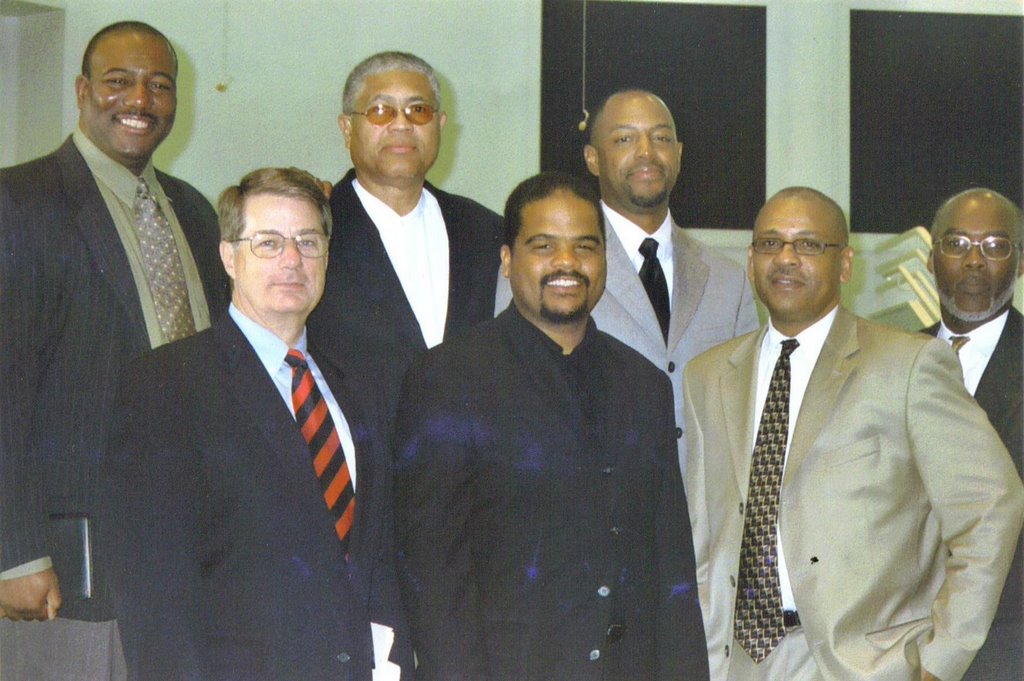 Speaking of our own, The Pastor's Conference at Glendale Baptist Church in Miami last year was among the best. This year promises to be even better. Make your plans to be there! The dates are out, Nov. 9 -11, 2006. The speakers are being lined up. So stay tuned for more information. In the meantime, mark your calendars and make plans to join us in Miami. Again, this is one of our own! (Pictured: 2005 speakers, from left to right: Lance Lewis, Robert Godfrey, Michael Leach, Sherard Burns, Anthony Carter, Kenneth Jones, Ricky Armstrong)
Monday, March 27, 2006
God Bless the Child...
 It was the irrepressible Billie Holiday who sang, "Papa may have...Momma may have...but God bless the child who's got his own." The more I reflect upon and engage with the broader Reformed community, I am becoming more and more inclined to believe that the growing African-American Reformed community may have to consider whether or not it would be more advantageous and beneficial to our calling and cause to have our own. At current, we are a culture within a culture. The predominantly white reformed culture, while welcoming to our public embracing and articulation of Reformed thought, demonstrates a reticence to speak on the nature of this embrace. This is because of old presuppositions and stereotypes. This has lead to an unwelcomeness of us as equals at the table. I don't say this as an indictment, only as a matter of conscience. It is not coincidental that the Reformed community is not more diverse than it is. It is not coincidental that the major voices in Reformed thought all look and sound the same. It is not coincidental that the majority of African-American reformed voices are more likely to address socio-economic issues rather than theological or ecclesiastical issues. It is not coincidently that African-American Reformed voices are more likely to be heard and quoted by the majority Reformed community when speaking on socio-economic issues than on biblical-theological ones. All of these and other situations were fostered and are perpetuated by a community that is very slow, and at times even hostile, to change or the admission of wrong. To this I say "Fine." I don't embrace Reformed thought because of who embraces Reformed thought, though I am not ignorant of the brilliant minds who have gone before me and have so eloquently set forth Reformed truth. Nevertheless, I embrace Reformed thought because I am convinced that it is the thought expressed in the pages of God's infallible Word. And yet I am not so myopic in my approach to theology and Christianity as to believe that my theology and beliefs have not cultural baggage attached ( unfortunately, many in the majority culture either consciously or subconsciously operate as if they don't). Having experiences that define who we are in the world that God has created is not a bad thing. Denying these experiences or not recognizing that these experiences pull us to extremes if not continually being informed by the Word of God is a bad thing. Therefore, I am inclined to suggest to my African-American brothers and sisters who embrace Reformed Theology that rather than being nudged or pushed into denying who we are, or being pulled into the extreme of over-emphasizing who we are, God's blessing to us and our subsequent contributions to the broader Reformed Community may come in our deciding to have our own.
Thursday, March 23, 2006
A New Birth
Keith Tolbert has written a very insightful and personal article entitled Why I Left New Birth Missionary Baptist Church. Keith was a faithful member of New Birth. He even had a personal relationship with Eddie Long. Yet the conviction of Scripture led him to the difficult and courageous decision to determine truth is more important than relationship. In fact, you have no relationship if it is not concerned for truth. Keith is seeking to walk in truth. You can judge for yourself if his reasons are valid.
Wednesday, March 22, 2006
How To Worship Well
Worship is not entertainment. Though there may be some entertaining qualities to worship and those who are enthralled by the entertainment industry do exhibit characteristics of worship[1], nevertheless, worship and entertainment have two differing and conflicting agendas. Entertainment is predominantly passive, whereas worship is predominantly active. Entertainment is audience-driven. Worship is God-driven. This is a key component to understand if we are going to worship well.
Unfortunately, too often, what we want in worship is entertainment because this is what we get during the week. This is really what most of us (young and old) are asking for without even knowing it. You see, from television to the theater, from computer programs to computer games, from instant messaging to instant coffee, this generation is treated to a wealth of entertainment, information, and resources graphically and instantly. It is fast-paced. It is always new and improved. This creates a low threshold for the slow-paced, meditative, reflective life that is often Christianity. The result is an easy boredom, and a lack of appreciation for the quietness and stillness that often are required in hearing from God. Thus when we come to church, we want in church what we so readily receive all the week long – fast-paced, up-to-the-minute, quality, graphic entertainment. Unfortunately, many places on Sunday morning give them what they want in an effort to reach them, or more accurately, woo them into membership. When this happens, according to Marva Dawn, “the focus then becomes not so much to display the glory of God as to delight the people who come” (How Shall We Worship, p. 67).
What is not realized is that these places are doing nothing more than scratching where people itch. They are perpetuating a superficial faith. They never penetrate to the deeper places of humanity and substantial Christian experience. This superficiality fails to lead people to see that a relationship, a lasting relationship with God is not accomplished in a fast-paced, hurried, entertainment-driven mode. It comes in getting before God and spending time, often long and quiet times, with Him. This indispensable exercise of Christian devotion is what church is supposed to prepare people for. This is what the church is to prepare people to encounter – a God who is bigger and better than we first imagined, but is never boring, even in the most quiet times.
Side Note: Our brother Eric Washington has recommended With Reverance and Awe by D.G. Hart and John R. Meuther as an excellent primer on Reformed worship by two reformed OPC thinkers. I would agree.
[1] According John M. Frame, “There are some criteria for good entertainment that are also criteria for God-honoring worship. In worship, sermons should be well-organized and clear, maintaining the attention of the worshipers. Music ought to be of high quality led by skillful (1Chron. 15:22; 2Chron. 34:12; Ps. 33:3) artists. It should be memorable, bring its text to dwell in the heart and mind. Thos in attendance should feel welcome, among friends. Humor is sometimes valuable in worship, since there is humor in Scripture itself. When these criteria are observed, worship inevitably becomes something like entertainment.” Contemporary Worship Music: A Biblical Defense (Phillipsburg, NJ: Presbyterian and Reformed Press, 1997), p. 60.
Monday, March 20, 2006
To Dress Up or Not to Dress Up...
that is the question. Over at Reformed Blacks of America they are debating the call to dress up or dress down for Worship Service. Those of us who have been around the church for any length of time would never have dreamed of darkening the church doors without our "Sunday's Best." But today, our generation has lost its sense of formality and has embraced a more casual, introspective approach to faith. This casual approach is not any less sincere (anyone who would question the spiritual sincerity of CJ Mahaney and many of my friends in Sovereign Grace would be woefully mistaken), but it does raise the question of how far should our casualness extend. Xavier says that our casualness may be a sign of our lackadaisical, careless attitude toward God. On the other hand, Lance says that casual dress may be the order of the day without minimizing the depth of one's faith in the slightest. What say you?
Thursday, March 16, 2006
The Implications of the Doctrines of Grace
 Reformed Theology is more than the Five Points of Calvinism. This is an undeniable truth. Yet, many of my brothers and sisters who embrace the Doctrines of Grace have not yet been exposed to the greater truths, the Reformed truths, that so naturally flow from the Doctrines of Grace. Reformed Theology is more than five doctrinal salvific points. It is an all encompassing worldview. And yet, this worldview is grounded in the truths that are embraced in the Five Points. Personally, I am convinced that if those who embrace the Doctrines of Grace would be exposed to and would come to understand the implications of these doctrines for all of life, they would find themselves moving beyond the elementary elements of TULIP unto the fuller expression of the Reformation, being that all of life is Soli Deo Gloria. One book that could help in this progression is When Grace Comes Home by Terry L. Johnson. Yet this book is not only helpful for those who need to move from the Doctines of Grace to a more full expression of Reformed Theology, it is also for those of us who have become too familiar with the Doctrines of Grace as to not appreciate the simply God-glorifying beauty and depths that so graciously flow from them. Ligon Duncan says, "We may still teach 'the doctrines of grace', but we have given little thought to the practical implications of sovereign grace. For this reason, and more, Terry Johnson's When Grace Comes Home is to be welcomed"
If you have read this work, share your thoughts. If you have not, I strongly commend it to your library.
Tuesday, March 14, 2006
Sherard Burns is Online
 For those so inclined (and we all should be) you can now listen to the sermons of Rev. Sherard Burns at www.ancf.org. Sherard is the Pastor of the church plant, All Nations Christian Fellowship in the Minneapolis area. I may be prejudiced, but Sherard is one of the finest and most courageous preachers I know. We rejoice that God has put him in the pulpit full-time and are eager to receive the fruits of his labors and God's gracious gift.
Monday, March 13, 2006
Calvinist or Reformed
As the community of Reformed African-Americans continues to grow, many in the traditional, long-standing Reformed community have been making remarks concerning the legitimacy of the Reformed confessions of these Christians. The remarks are not meant to be malicious (so I don't think), nor are they offered with any vindictive tones. However, they are meant to bring into question just how reformed are these so-called reformed Christians. Because most of these African-American Christians come from a Baptist background and not a Presbyterian (which is another topic in itself), and because most of them have found access to Reformed beliefs by way of the Doctrines of Grace, the primary remark comes in this or a similar vein: "Well, they are Calvinistic, but not necessarily Reformed." While there is some truth in this statement, it tends to foster an unhealthy division between brothers of like mind, rather than doing what the commenter probably intends to do, and that is to challenge these "calvinist" to become "reformed." Admittedly, I borrow loosely the words of Paul and say that I thank God that I am more reformed than most and wish that all my brothers and sisters were as I am. Nonetheless, I ask those who are "so reformed" to be patient with those who are "reforming." Obviously, being Reformed is more than being Calvinistic, but surely it is nothing less. Therefore, that brothers and sisters would embrace the Doctrines of Grace when they have for the vast majority of the Christian experience been inundated with the Doctrines of Disgrace (Arminianism), should cause us to rejoice. We should realize that these brothers and sisters have been set free from the Dungeon of the Giant Despair and have been set on the road to the King's Gate, having been given a gracious vision of the Celestrial City. Unfortunately, many us forget from whence we come, and just how unreformed, and uninformed we were when we set out from the City of Destruction.
A Christian Philosopher and Teacher
Dr. Ronald Nash passed last week. He was Professor of Philosophy and Apologetics at Reformed Theological Seminary while I was attending. He was not the most affable person, but man could he teach. I learned as much about the foundations for clear Christian thinking from Dr. Nash as I learned from anyone. His gifts and contributions to the development of the Christian worldview will be missed.
Monday, March 06, 2006
The Next King a Bishop?
Now that the Coretta King's funeral has past into our memories, some are beginning to analyze what messages have been left in its wake. One such person is Dr. Robert M. Franklin, Jr., Distinguished Professor of Social Ethics at Candler School of Theology at Emory University. Apparently, Dr. Franklin was not impressed with Bernice King's attempt at passing the mantle of Black Leadership from her father, M.L. King Jr. to her bishop Eddie Long. According to Franklin, the use of New Birth Missionary Baptist Church as the funeral site sent mixed messages to a world in need of the pathos and vision of a Dr. King. Dr. Franklin has many other points to make in his Reflections on the Funeral and the Future of the Movement.
What is the Black Church?
Michael Leach is raising some provocative questions concerning our definition and understanding of the "Black Church." You can read them for yourself at Lux et Veritas. So penetrating are some of his questions, I concluded that he is not just speaking to the predominantly Black church in America, but to the church universal.
Wednesday, March 01, 2006
All Nations Christian Fellowship
This coming weekend is the kick-off worship service for the church plant, All Nations Christian Fellowship in the Minneapolis, MN area. Sherard Burns will be the preaching pastor, and all those called to be under his preaching will be blessed. Without a doubt, there is a need for more biblically grounded churches. As we search around our neighborhoods, and find more church buildings than necessary, we are moved to lament the availability of solid, well-rounded, biblically grounded churches. The challenge today is for more churches to plant churches that will go forth with biblical, historical, and experiential Christianity (Reformed Christianity, that is). John Piper expressed this need in a brief statement concerning the planting of All Nations Christian Fellowship. Also, By Faith Online, the bi-monthly magazine for the Presbyterian Church of America, has a excellent article on this issue entitled The Joy of Planting New Churches. The article begins:
"What would you guess is the most effective way to reach nonbelievers for
Jesus Christ: Evangelistic crusades? Special outreach events? Formal witnessing
programs? Parachurch ministries targeting specific types of people? Actually,
none of the above. PCA experts on evangelism and church growth agree that the
most consistent, fruitful way of taking the gospel to the lost is to plant new
churches."
Let us pray for All Nations Christian Fellowship. Let us pray for Sherard and the leadership of this church. And let us pray that God will raise up more brothers with a vision for church planting that will continue this movement of the rebirth of Reformed theology in our day.
Another Word on Worship
Marva Dawn:
"It seems to me that the command in Psalm 96, correlatively, reminds us that we have no right to worship the LORD. We can do so only because of God's immense forgiveness and condescension. An awareness of this will fill us with profound wonder at the great privilege of worship and the enormous gift of God's pardon!"
Subscribe to:
Posts (Atom)